Configuring an F-Value Application Channel
An F-Value Application channel outputs a single analog value that represents the cumulative sterilization effect, expressed as the equivalent time in minutes at the sterilization temperature. The calculation accounts for the entire temperature profile including periods below, at and above the sterilization temperature.
To access, add and configure an F-Value Application channel:
From the EPM User Interface screen, select Options  - Functions - Applications:
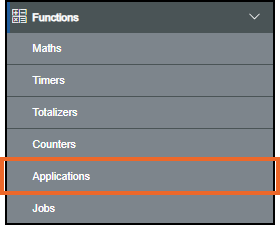
Select from the following options to expand the details:
 Adding an F-Value Application Channel
-
From the left-hand side of the Applications screen, select Add Application
 :
: -
If you are not already in Configuration lock, the Configuration lock screen displays
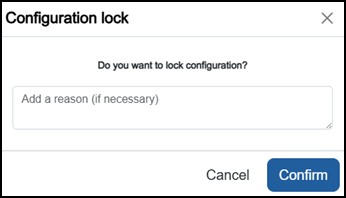
Enter a reason if required and then select Confirm
 . The system configuration is now locked pending the submission of your update and the Configuration Locked
  icon displays on the status bar.Note - Configuration lock does not affect the operation of the EPM device.See Configuration Lock for details.
 -
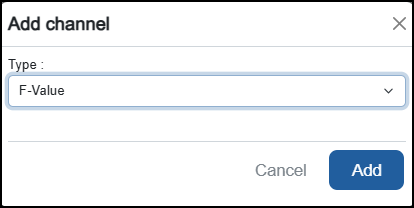
The Add channel screen displays, from Type, select F-Value from the available list and select Add
 :
:
Configuring an F-Value Application Channel
-
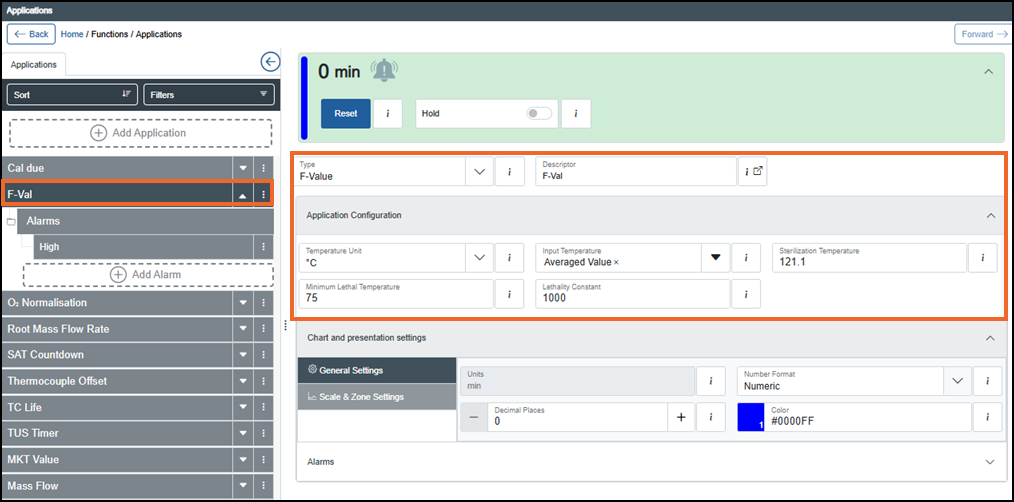
From the left-hand side of the Applications screen, select the F-Value Application channel required. The Application Configuration section displays on the right-hand side
-
If you are not already in Configuration lock, the Configuration lock screen displays
Enter a reason if required and then select Confirm
. The system configuration is now locked pending the submission of your update and the Configuration Locked icon displays on the status bar.Note - Configuration lock does not affect the operation of the EPM device.See Configuration Lock for details. -
Complete the configuration as required:
-
Type - Defaults to F-Value.
-
Descriptor - Defaults to Application <n> where n is the next number in sequence from the previous Application channel. We recommend that you enter a unique name for the channel (max 40 characters), for example, “f-val” or “Sterilization F-Value”.
Note - This is not case sensitive, for example, 'AbC' is regarded as identical to 'abc'.Tip - When an External link icon displays next to a function’s Descriptor, it indicates that one or more of its parameters are mapped to a Modbus server register table. Select External link to display the Modbus register address, data type and related mapping details, which enables alignment with the exported Modbus register map. See Exporting a Modbus Address Map for details.
 -
Application Configuration - Select Expand
 if it does not expand automatically:
 -
Temperature Unit - Defaults to °C. Select the unit of measurement for the temperature parameters from the available list (°C, °F, K or °R)
Centigrade, Fahrenheit, Kelvin or Rankine. -
Input Temperature - Current measured temperature.
Select a dynamic data source, for example, an I/O channel or Maths channel from the available list or enter a numeric constant, see Linking a Channel as an Input for details.
-
Sterilization Temperature - Defaults to 121.1 °C. Enter the reference sterilization temperature.
-
Minimum Lethal Temperature - Defaults to 75 °C. Enter the lowest temperature lethal to expected contaminants.
Tip - Referred to as 'Low cut off' in a 6000 series recorder. -
Lethality Constant - Defaults to 10 °C. Enter the number of degrees the temperature must be increased by to achieve a factor-of-ten (1 Log 10) reduction in the number of organisms.
Tip - Referred to as 'Temperature interval' in a 6000 series recorder.
-
-
Configuring Chart and Presentation Settings
-
From the left-hand side of the Applications screen, select the F-Value Application channel required. The Chart and presentation settings section displays on the right-hand side.
-
If you are not already in Configuration lock, the Configuration lock screen displays
Enter a reason if required and then select Confirm
. The system configuration is now locked pending the submission of your update and the Configuration Locked icon displays on the status bar.Note - Configuration lock does not affect the operation of the EPM device.See Configuration Lock for details. -
From Chart and presentation settings, select Expand
if it does not expand automatically and complete as required:-
General Settings:

-
Units - Defaults to min.
Tip - The unit displays with the channel value. -
Number Format - Select either:
-
Numeric - Displays numbers in a decimal format, for example, 12345.6789 displays as 12,345.6789.
-
Scientific - Displays values in scientific notation, which is useful for very large or very small numbers. Values display as a coefficient multiplied by a power of 10. For example, 12345.6789 displays as 1.23456789E+4.
-
-
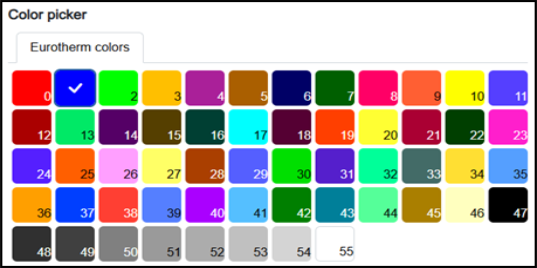
Color - Select a color to display the channel from the 56 available colors:
-
-
Scale & Zone Settings:
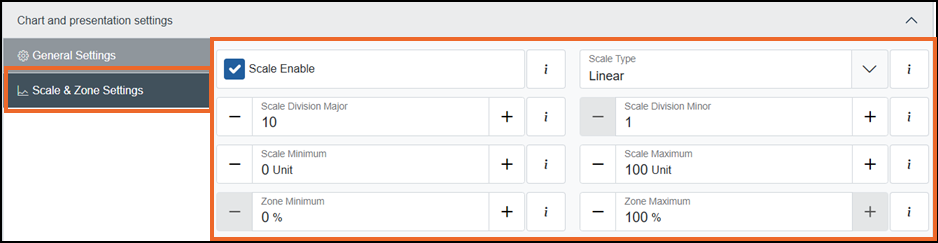
To set the chart scale and zoning for this channel:
-
Scale Enable - Tick to enable scale configuration and specify the scale type and the number of divisions required:
-
Scale Type (available only when Scale Enable is enabled) - Select one of the following options:
-
Logarithmic - Divisions are displayed using a logarithmic scale. This option is suitable for analyzing data spanning multiple orders of magnitude.
-
Linear - Divisions are displayed at equal intervals. This option is ideal for displaying uniformly distributed data:
-
Scale Division Major (available only when Scale Type is Linear) - Enter a value, or use the Plus
 and Minus
  to set the major divisions to be included on the chart (valid range 1 to 20).
 -
Scale Division Minor (available only when Scale Type is Linear) - Enter a value, or use the Plus
and Minus to set the minor divisions to be included on the chart (valid range 1 to 20).Note - Scale divisions have no impact on a chart grid, they are only for scale. The grid on the chart is defined by the division settings on the group, see Configuring Groups Settings for details.
-
-
-
-
Scale maximum (Unit) - Enter a value, or use the Plus
and Minus to set the upper limit of the scale's range. -
Scale minimum (Unit) - Enter a value, or use the Plus
and Minus to set the lower limit of the scale's range. -
Zone maximum (%) - Enter a value, or use the Plus
and Minus to set the percentage offset for the upper limit of the scale and trendline relative to the top of the chart (valid range 5 to 100). -
Zone minimum (%) - Enter a value, or use the Plus
and Minus to set the percentage offset for the lower limit of the scale and trendline relative to the bottom of the chart (valid range 0 to 95).Note - The minimum value must be less than the maximum value by 5 or more.Tip - The Zone settings offset a scale and its associated trendline relative to the chart grid. This is useful when displaying multiple trends with similar value ranges, which would otherwise overlap and become difficult to distinguish. For example, several digital trends switching between 0 and 1 can overlap, making them difficult to distinguish unless each is defined a different Zone.
-
-
 to configure an alarm on this channel, see Configuring an Alarm for further details.
Once complete, select Review pending changes  screen to review updates to the configuration, and submit them. See Reviewing and Submitting Changes for details if required.
Last update - April 2026